
For most people who wake up congested, the problem in the bed is not down. It is house dust mites and the allergen in their waste, which accumulate in any bedding regardless of what it is filled with. True allergy to down protein exists but is uncommon; allergists more often trace bedroom symptoms to mite allergen, and sometimes to residues left on poorly processed fill.
That distinction changes what you should shop for. If the fill type were the trigger, the answer would be simple avoidance. Because the trigger is usually a living population inside the bedding, the answer is about weave density, washability, and routine — and a well-made down comforter can perform as well as a synthetic one on all three.
What is actually in the bed
Dust mites are microscopic and harmless in themselves. They feed on shed skin cells and thrive in warm, humid environments, which describes the inside of a bed almost exactly. The allergen is in their droppings and fragments, which are fine enough to become airborne when bedding is disturbed — that is why symptoms often peak on getting into bed and on waking.
They do not care whether the fill is down or polyester. What they care about is whether they can get into the fill, whether there is a food supply, and whether the humidity suits them. So the question is not “down or not down.” It is: can they get in, and can you get them out?
Three things that decide whether a down comforter suits an allergy household
1. How tightly the shell is woven. This is the single most important factor and the one most often ignored. A dense, high-thread-count shell functions as a physical barrier: mites cannot easily migrate into the fill, and allergen inside cannot easily migrate out. A loosely woven shell fails at both. Thread count is a rough proxy here, but the more meaningful signal is that a shell is dense enough to contain fine down clusters at all — a fabric that holds 650 fill power down without leakage is already a fairly tight weave. This is why a down comforter for allergy sufferers should be judged on shell density before anything else: a tightly woven organic cotton shell holds up far better in an allergy household than a lightly built one carrying identical fill.
2. How thoroughly the down was cleaned. Raw down carries dust and organic residue. Reputable manufacturers wash it repeatedly before it goes anywhere near a shell, and the number of washing stages is a meaningful spec rather than marketing. Poorly cleaned fill is a genuine irritant, and it is probably responsible for a share of the reputation down has among allergy sufferers.
3. Whether you can wash the finished comforter. Everything on this list decays without maintenance. A comforter you can wash at home once or twice a year, and a cover you can strip weekly, will outperform a technically superior product you never clean.
The specs, in plain terms
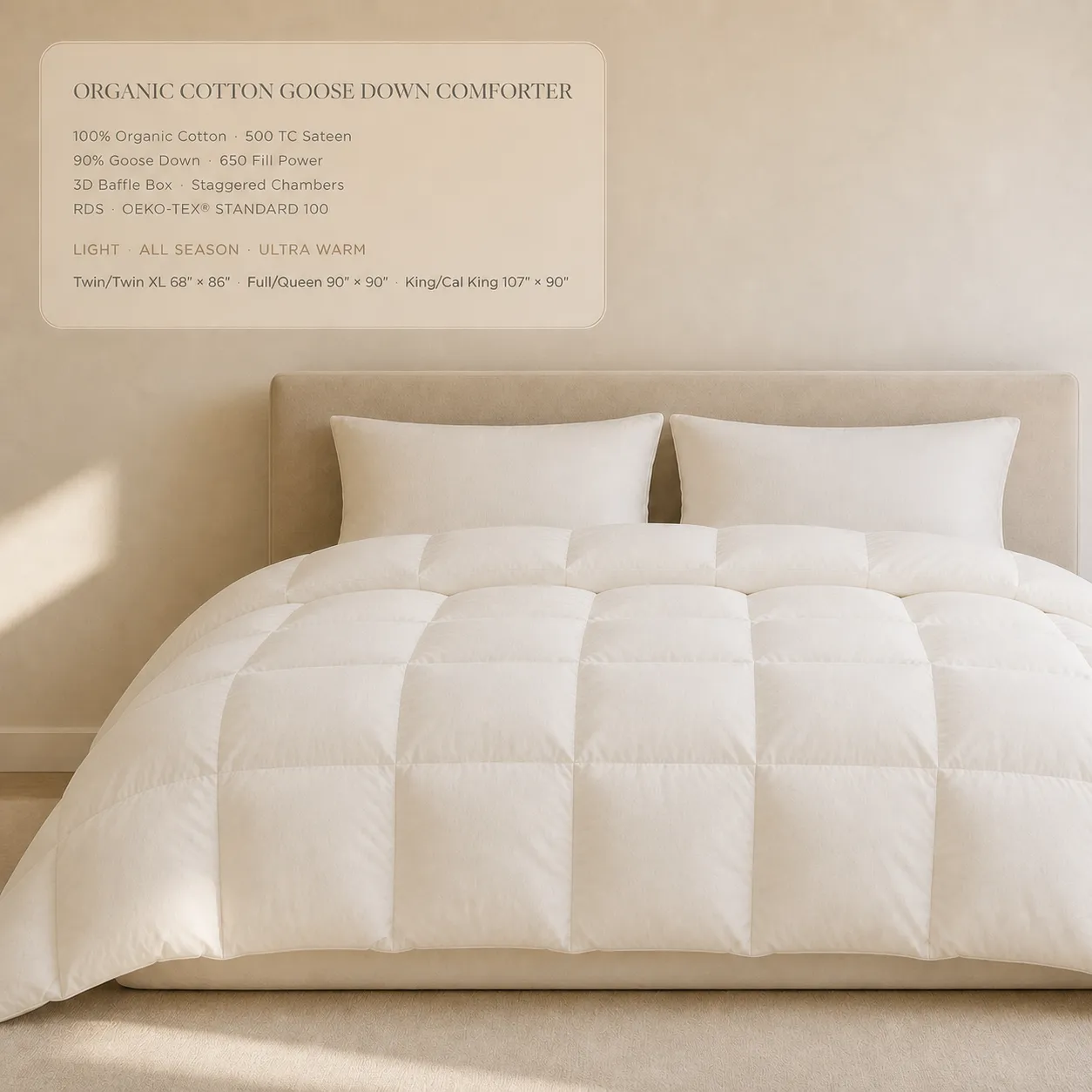
The certification line is the one to read carefully in this context, because the two standards cover different things and neither is an allergy claim. OEKO-TEX® STANDARD 100 certifies that the finished textile has been tested against a list of harmful substances — relevant if your concern is chemical sensitivity or contact irritation rather than mite allergen. Responsible Down Standard (RDS) certifies the sourcing and animal welfare chain behind the fill, and says nothing about allergens at all. IDFL, which appears on some down products, is the independent laboratory that verifies down and feather content claims. Knowing which certificate answers which question saves a lot of confusion in a category where the logos tend to be presented as interchangeable badges of quality.
The pillow is a bigger problem than the comforter
If symptoms are worst in the morning, look at the pillow before the comforter. Your face is in direct contact with it for hours, it absorbs far more moisture, and most people replace pillows far less often than they should.
Two practical moves help. First, use a zippered pillow protector under the pillowcase and wash it monthly. Second, choose a fill you can actually maintain: a natural latex pillow, for instance, has a dense structure that is difficult for mites to colonise and can be aired and wiped down, which is a different maintenance model from a fill that has to be laundered to be cleaned. Neither is inherently “the allergy pillow” — the useful question is which one you will keep clean.
Humidity and the weekly routine
Dust mites need ambient moisture. Keeping bedroom humidity in the moderate range — broadly the same range that suits comfortable sleep — makes the environment materially less hospitable, and it is often easier to change than anything else on this list. Ventilating the room in the morning, rather than making the bed immediately, lets the moisture your body released overnight leave the bedding instead of being sealed in.
The rest is routine. Wash sheets and pillowcases weekly in the hottest water the fabric tolerates, and keep a second set in rotation so that the changeover never gets postponed — keeping two organic cotton sheet sets in circulation makes the weekly change automatic rather than a decision. Wash the duvet cover on the same schedule. Air the comforter itself for an hour or two every few weeks. Vacuum the mattress surface when you change the sheets.
Who should still avoid down
Some people genuinely react to down or feather protein, and a small number react to feather rather than down specifically, which is why fill composition ratios can matter. If you have had a confirmed reaction, or if symptoms persist after several weeks of a strict cover-and-wash routine with a tightly woven shell, that is a reason to test a different fill rather than to keep optimising. It is also worth saying plainly that no bedding purchase substitutes for a diagnosis; if symptoms are significant, an allergist can identify the actual trigger far faster than trial and error with bedding can.
For everyone else, the Warmy Tummy Organic Cotton Goose Down Comforter and products like it are not the obstacle they are often assumed to be. The obstacle is a bed that never gets stripped.
FAQ
Are down comforters bad for people with allergies?
Usually not. True allergy to down protein is uncommon; most bedroom symptoms come from dust mite allergen, which accumulates in any bedding regardless of fill. What matters is whether the shell is woven tightly enough to keep mites out of the fill, whether the down was thoroughly cleaned before manufacture, and whether you wash the cover and sheets regularly.
Do dust mites live in down comforters?
They can, but a tightly woven shell makes it difficult for them to reach the fill, so they mostly live in the outer layers of bedding, mattresses and pillows. That is why a washable duvet cover matters more than the fill type. Weekly hot washing of covers, sheets and pillowcases removes the great majority of the allergen load in a bed.
Does OEKO-TEX certification mean bedding is hypoallergenic?
No. OEKO-TEX® STANDARD 100 certifies that a finished textile has been tested against a defined list of harmful substances, which addresses chemical exposure rather than allergens like dust mite protein. Responsible Down Standard (RDS) covers sourcing and animal welfare, not allergens. Neither is a medical claim, and neither replaces a washing routine or a consultation with an allergist.